
How to Shape Drainage Swales That Work
A hard Texoma rain can show you exactly where a property’s drainage fails. Water cuts across a gravel driveway, ponds at a foundation pad, washes a pasture gate, or turns a low spot into mud that will not dry out. The answer is not always more rock or a bigger ditch. Often, the job starts with knowing how to shape drainage swales so runoff has a clear, controlled route off the property or toward a safe outlet.
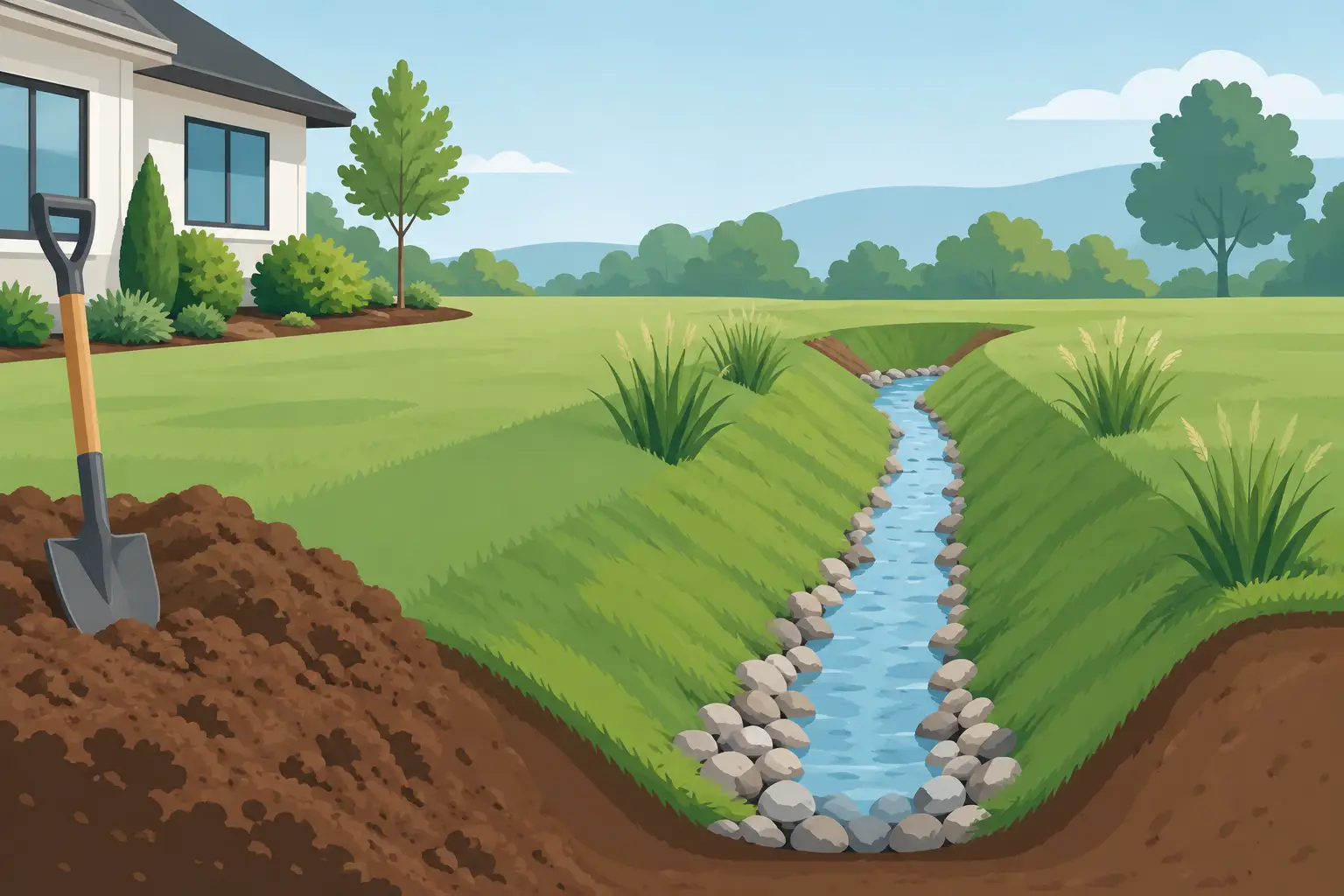
A swale is a broad, shallow channel built into the grade. Unlike a deep roadside ditch, it is meant to collect sheet flow and carry water gradually without becoming an erosion problem itself. When the layout, slope, and outlet are right, a swale protects the parts of a property that need to stay usable: building pads, roads, parking areas, barns, gates, arenas, and working pasture.
Start With Where the Water Is Coming From
Before cutting a swale, look at the whole drainage path. Water does not care about property lines, fence lines, or where a driveway would look best. It follows the low ground, picks up speed on slopes, and collects anywhere the grade runs out of fall.
Walk the property after a rain if possible. Look for washed gravel, standing water, ruts, sediment deposits, wet fence corners, and grass that lays flat in one direction. Those signs show where water enters, where it concentrates, and where it is trying to leave. On a new build, the same information comes from existing contours, nearby drainage features, and finished elevations planned for the pad, road, and surrounding ground.
The key question is simple: where can the water go without creating a new problem? A swale must have a positive outlet. That may be a natural drainageway, a properly sized culvert, a pond designed to receive runoff, or a lower area that can safely handle the flow. Sending water toward a neighbor’s structure, across a public road, or into an unprotected low spot only moves the trouble downstream.
Shape Drainage Swales With Broad, Stable Slopes
A functional swale is usually wider and flatter than people expect. Sharp V-shaped trenches can carry water, but they concentrate flow, are hard to mow, and can erode quickly in sandy or disturbed soil. Broad side slopes spread the water out and make the finished ground easier to maintain.
The bottom should be smooth and continuous, with no humps that trap water and no abrupt drops that create scour. The side slopes should tie naturally into the surrounding grade. On a residential yard or pasture, that often means the swale looks like a gradual low area rather than a ditch cut with a narrow bucket.
Depth and width depend on how much water the swale will handle. A small swale below a roof-drainage area is not the same as one taking runoff from a long gravel drive, metal shop roof, hillside, or commercial parking area. The contributing area, soil type, ground slope, and local rainfall all affect the size needed.
For larger drainage paths, equipment control matters. A dozer can establish broad fall across open ground. A skid steer can fine-grade smaller areas and shape transitions near homes, shops, and driveways. An excavator may be needed where the swale ties into a deeper outlet, culvert, or pond. The right machine is less about preference and more about building the intended grade without tearing up more ground than necessary.
Give the Swale Enough Fall
Water needs slope to move, but too much slope can turn a swale into an erosion channel. A very flat swale may hold standing water, especially in clay-heavy ground. A steep swale can gain speed fast during a heavy storm and cut through bare soil, mulch, or loose fill.
That balance is why drainage work should be graded to actual elevations rather than judged by eye alone. A laser level or grade-control equipment helps establish a steady fall from the collection point to the outlet. The finished bottom does not need to look steep. It needs to drain consistently.
Where the land drops quickly, slowing the water may be more important than making the channel deeper. A wider section, vegetation, rock protection, or a series of grade changes can reduce velocity. Where the ground is nearly flat, the solution may involve adjusting larger areas of grade so water can reach the swale in the first place.
Keep Runoff Away From Pads and Driveways
Building pads and access roads should sit above the surrounding drainage pattern, not directly in it. If runoff is allowed to run toward a pad, water can soften subgrade, undermine edge slopes, and collect beside slab areas. A properly placed swale intercepts that flow before it reaches the structure.
For a foundation pad, the surrounding ground should drain away from the building area. The swale is generally located far enough from the pad to avoid creating a soft trench beside it, while still catching runoff coming from higher ground. The exact location depends on site layout, utilities, retaining needs, and final landscaping.
Driveways need similar attention. Gravel roads commonly fail because water is running down the wheel tracks or trapped against the road edge. The road surface needs crown or cross-slope to shed water, and side drainage needs a route that stays open. A swale along the uphill side can intercept runoff before it crosses the drive. On the downhill side, a ditch or swale may carry water away after it leaves the road.
If water must cross a driveway, use a culvert sized for the expected flow and set at the proper grade. A culvert without a maintained inlet and outlet is just a buried restriction. The swale leading into it must be shaped to guide water in smoothly, and the discharge end needs protection if flow could scour the soil.
Protect the Swale From Erosion
Freshly graded soil is vulnerable. One hard storm before grass establishes can undo clean finish work, especially on slopes or in sandy ground. The protection needed depends on flow volume and soil conditions.
Vegetation is often the best long-term finish for a broad swale. Grass holds the soil, slows runoff, and keeps the channel easier to maintain. It needs time and moisture to establish, though, so a newly shaped swale may need temporary erosion control until it takes hold.
Rock is useful where water enters or exits at higher speed, such as below a downspout outlet, at a culvert end, or at a concentrated transition. Clean rock can armor a vulnerable area, while the material below it may need separation fabric or proper base preparation depending on the soil. Rock placed randomly in the middle of a poorly graded swale will not correct a flat bottom or a bad outlet.
In some cases, a swale needs a combination of grassed sections and reinforced points. That approach keeps most of the area maintainable while protecting the locations where runoff has the most energy.
Avoid Common Swale Problems
The most common drainage mistake is digging first and planning the outlet later. Every swale should be part of a complete path from collection to discharge. Another frequent problem is making the channel too narrow. It may look clean on day one, but it can become a rut, mowing obstacle, or erosion line after repeated storms.
Spoil placement matters too. Dirt pushed along the downhill side of a swale can accidentally create a berm that traps water in the channel. The same issue happens when driveway gravel, landscaping, or fence work blocks a low outlet. Drainage features need to remain clear after the rest of the property improvements are complete.
Do not overlook underground utilities, septic components, easements, or existing structures. Surface grading can affect more than surface water. Changes around a septic field, for example, should be planned carefully to avoid directing concentrated runoff where it does not belong.
When a Swale Is Not Enough
A swale is a practical drainage tool, but it is not the answer to every wet-property problem. If a low area has no outlet, a swale alone cannot make water disappear. The project may need regrading across a larger area, a culvert connection, a pond, additional drainage structures, or imported select fill to raise a usable building or road area above the wet ground.
Likewise, if runoff is coming off a large roof, paved surface, or upstream tract, the flow may exceed what a shallow grassed swale can safely carry. Bigger drainage paths need proper sizing and may require more substantial erosion protection. The goal is not to force every problem into one solution. It is to build drainage that fits the land and the amount of water moving across it.
A well-shaped swale should not draw attention after the job is done. It should simply keep the driveway firm, the pad dry, and the ground usable when the next hard rain hits.